
Crew Induction
Thank you for registering to be a part of the Sydney Marathon 2025!
Prior to commencing work on the Sydney Marathon, we require all staff to complete the below induction. Please read all of the relevant WHS information below and then complete the form at the bottom of the page by Friday August 22. Any questions, please contact cassia@tedandco.com.au.
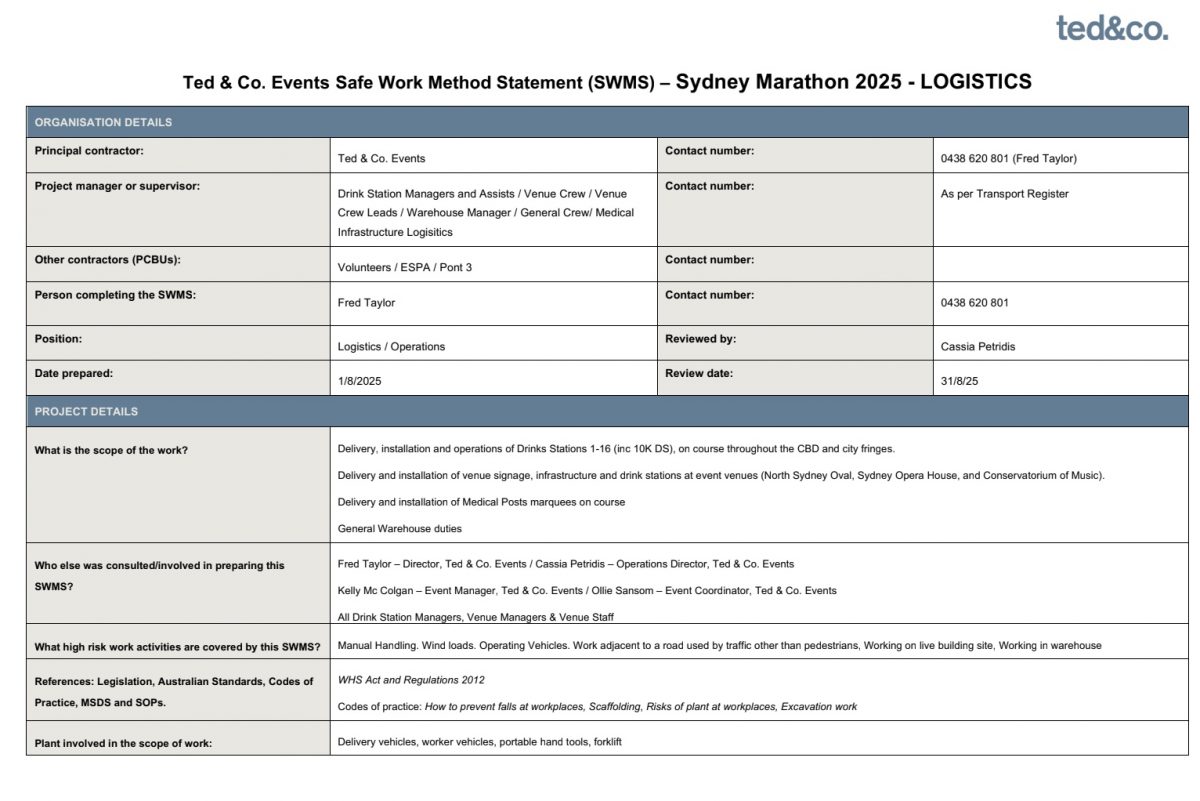
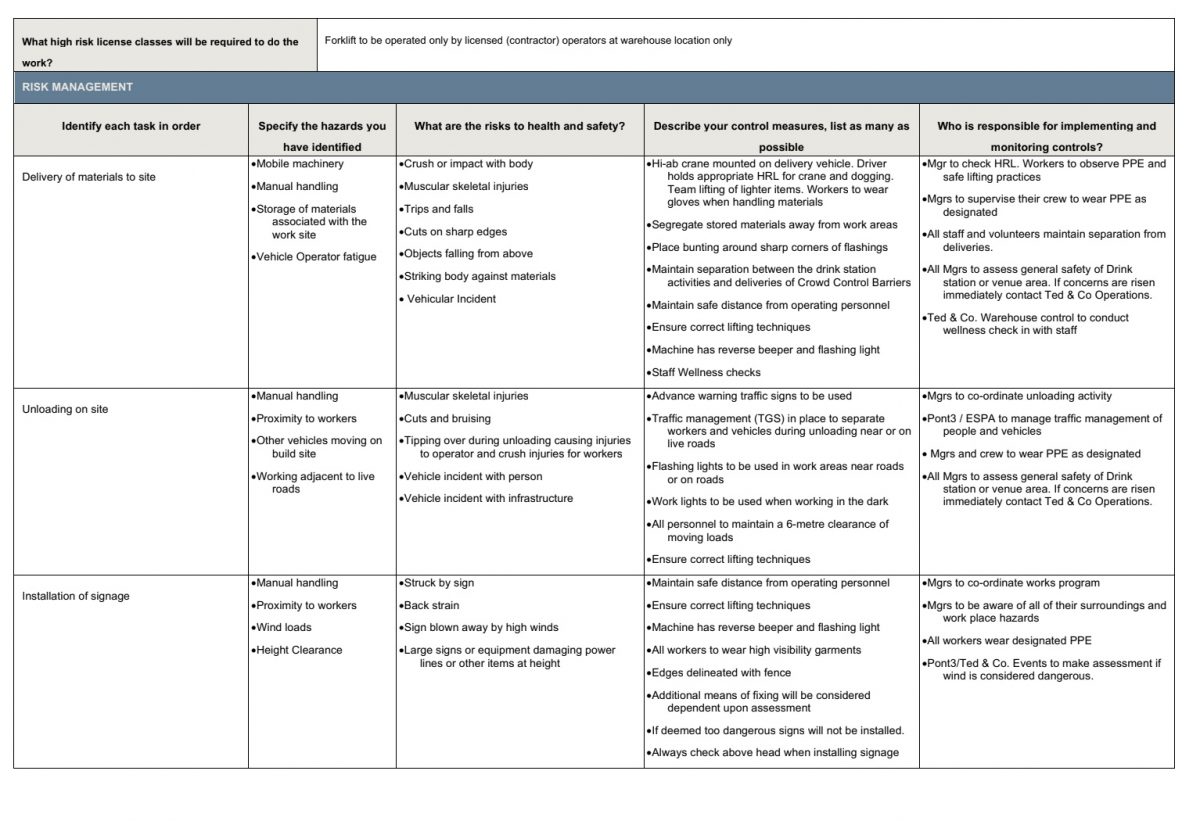
Section 1: Ted & Co. SWMS:

Section 2: Ted & Co. Safe Handling Induction Process:
Manual handling is a specific hazard that requires special training and information in the policies and procedures that you have established to manage safety in your organisation. Prior to this detailed training, new workers should receive induction training that includes information about:
- Health and safety responsibilities;
- How consultation takes place;
- Reporting hazards, incidents and injuries;
- General safety rules and policies, such as following safe work procedures, using PPE, prevention of bullying, drugs and alcohol;
- Training and information requirements for specific tasks, such as safe work procedures, material safety data sheets and operators’ manuals;
- Emergency procedures; and
- Return to work program and workers compensation.
Review your induction training program periodically to ensure that it is up to date and effective. Where appropriate, provide the information in a training manual and distribute it to your workers.
Lifting Safety: Tips to Help Prevent Back Injuries
Have you checked the object before you try to lift it?
- Test every load before you lift by pushing the object lightly with your hands or feet to see how easily it moves. This tells you about how heavy it is.
- Remember, a small size does not always mean a light load.
Is the load you want to lift packed correctly?
- Make sure the weight is balanced and packed so it won’t move around
- Loose pieces inside a box can cause accidents if the box becomes unbalanced
- Perform a variety of work tasks during the day
- Alternate between tasks wherever possible
- Perform movements smoothly in a comfortable balanced posture with minimal bending, twisting and overreaching
- Change your posture and working position throughout the day to avoid prolonged sitting or standing
- Take regular breaks from repetitive tasks
- Position tools, controls, equipment or furniture to allow work to be done in a comfortable upright position with most work carried out at waist level
- If you have to keep reaching for something move it closer
- Provide adequate space so you are not working in a cramped position – your work space should be uncluttered and well lit
- Try to avoid working on areas of floor that are cluttered, uneven, wet or slippery
- Wear proper clothing and footwear (personal protective equipment) e.g. gloves, non-slip shoes, apron.
Proper Lifting Technique
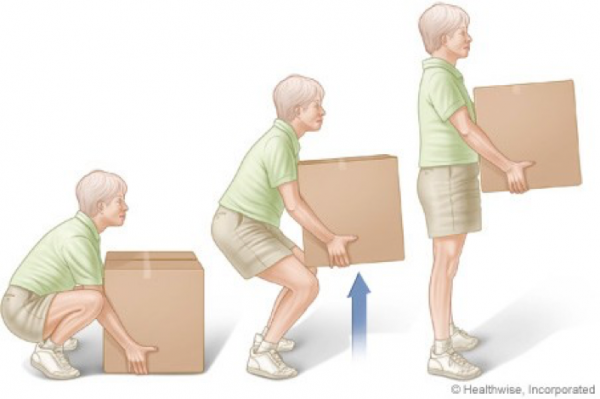
Follow these tips to avoid compressing the spinal discs or straining your lower back when you are lifting:
Keep a wide base of support. Your feet and be shoulder-width apart, with one foot slightly ahead of the other (karate stance).
Squat down, bending at the hips and knees only. If needed, put one knee to the floor and your other knee in front of you, bent at a right angle (half kneeling).
Keep good posture. Look straight ahead, and keep your back straight, your chest out, and your shoulders back. This helps keep your upper back straight while having a slight arch in your lower back.
Slowly lift by straightening your hips and knees (not your back). Keep your back straight, and don’t twist as you lift.
Hold the load as close to your body as possible, at the level of your belly button.
Use your feet to change direction, taking small steps.
Lead with your hips as you change direction. Keep your shoulders in line with your hips as you move.
Set down your load carefully, squatting with the knees and hips only.
Keep in mind:
- Do not attempt to lift by bending forward. Bend your hips and knees to squat down to your load, keep it close to your body, and straighten your legs to lift;
- Never lift a heavy object above shoulder level; and
- Avoid turning or twisting your body while lifting or holding a heavy object.
Section 3: White Level Inspection:
Checking Area of Operation (White Level Inspection)
Purpose & Objective:
- Provide crew with a procedure on how to conduct a white level inspection
- Provide appropriate reporting channels
- Reminds employees to remain vigilant of suspicious or unusual behaviour
- Understand the reporting arrangements when such behaviour has been identified
Refer to NSW police message:
“It is important to be alert on a daily basis to any security and safety issues. One method of maintaining awareness is to conduct White Level Inspections”
- A White Level Inspection involves looking for any articles that are unusual, cannot be accounted for, or are suspicious.
- The people in the best position to conduct these inspections are those who know and work within the area.
- Inspection ensure the maintenance of a secure workplace and in the integrity and safety of the site.
- Inspection areas are small areas, which can quickly be inspected by the staff who usually work there.
- When conducting a White Level Inspection visual checks should be made of:
- the route to the work area
- the work area
- In the event that a foreign item is identified which is either hidden, obviously suspicious or is not a typical item found in that area:
- do not attempt to touch or move the item
- report it to your supervisor immediately & await instructions.
The safety of all crew, volunteers, participants and spectators at all times is of high importance:
- All crew & volunteers must be aware of their surroundings at all times.
- Expect Event Vehicles on the Field of Play (FOP)* and take caution.
****The FOP is the area set up for runners allowing for a clear and accurate route*** - Although road closures apply be aware that some surrounding roads are not subject to closures.
- Residential vehicles may leave their driveways throughout the day, take caution.
- In some areas of the course only one side of the roadways are closed to normal traffic.
- Be attentive to your surroundings at all times to ensure the safety of yourself and all of those people around you.
- Identify any obstacles on the FOP (i.e non event vehicles, rubbish etc) to Logistics Control on Channel 4.
- Remove if it is safe to do so as to ensure a safe environment for the runners.
Please remember to expect the unexpected and be alert to your surroundings at ALL times. Safety is the first priority!
Section 4: Emergency Procedures
Emergency Procedures
- Stay calm and think clearly when confronted with an Emergency
- For ANY emergency Dial ‘000’ FIRST,
- Contact should be through to Logistics Control on Channel 4 who will then report the incident to the Event Operations Centre (EOC) on Channel 1.
- Before doing so, remember to:
- IDENTIFY what and where the emergency has occurred,
- KNOW your exact location,
- VERIFY that there is an emergency and not a miscommunication,
- COMMUNICATE the issue to your Team Leader or Workforce Manager,
- AWAIT INSTRUCTIONS
- It is vital that the EOC is notified of any emergency calls
- An incident report from your Drink Station Manager briefing document must be completed and handed back to Logistics Control upon returning to the warehouse. It is important that you take note of the participant’s race number indicated on their race bib for identification purposes if the emergency or incident involves a runner. If a member of the general public take note of as much information as possible – physical description, any details if they are with friends like name, address, contact number.
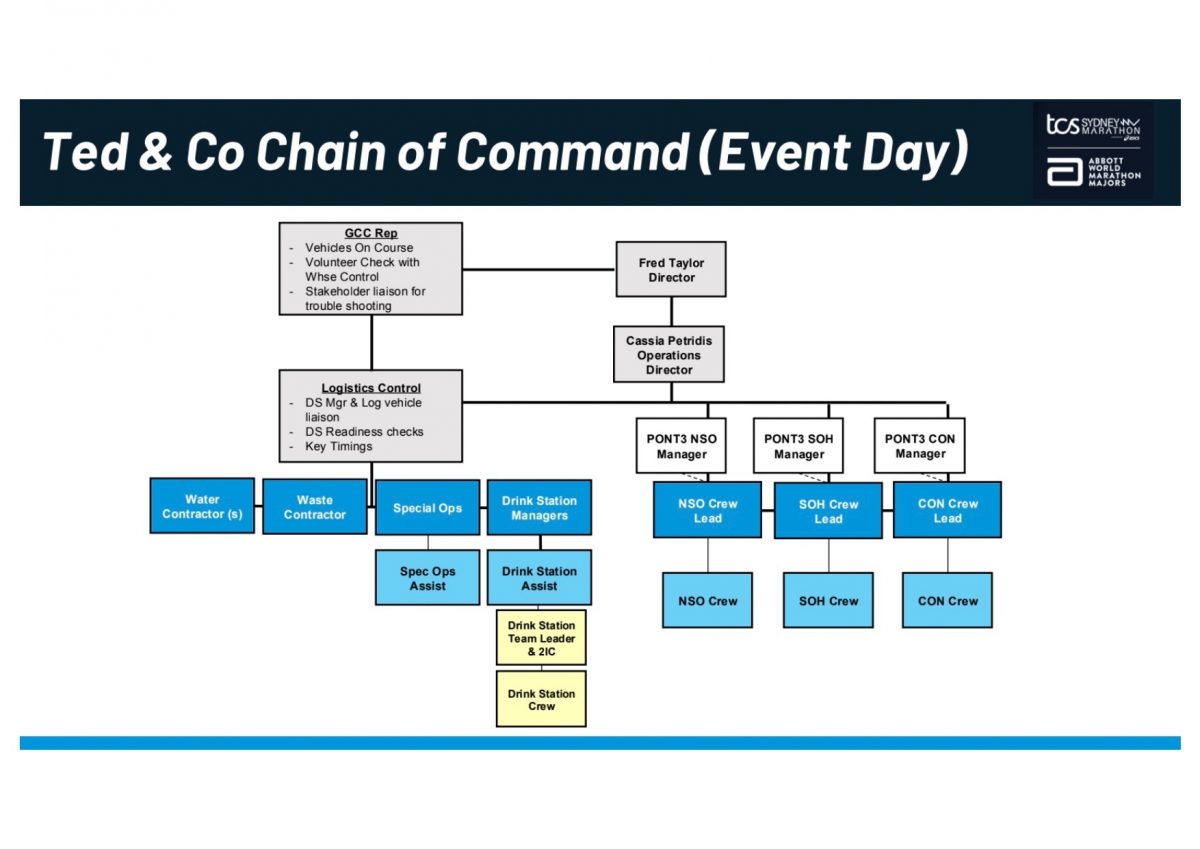
In the instance of an Emergency, all Ted & Co. Events staff assume the role of Warden and should await instructions from the leadership team.
Section 5: Ted & Co. Events Health and Safety Policy
Ted & Co. Events is involved in the management of event and consulting to event owners and stakeholders.
The Director of Ted & Co. Events fully accepts his responsibilities to his employees (this includes any person who works as an employee, trainee, volunteer, outworker, apprentice, contractor or sub contractor) to ensure so far as is reasonably practical their health, safety and welfare and to:
- Provide and maintain within the framework of law and of good practice, safe and healthy working conditions, equipment and systems of work for all of our employees, contractors, visitors and others.
- Make arrangements to ensure so far as reasonably practical safety and absence of risks to health in connection with the use, handling, storage and transport of articles and substances.
- Provide information, instruction, training and supervision as is necessary to ensure so far as is reasonably practical the health and safety at work of our employees.
- Maintain in a condition to be safe and without risks to health so far as is reasonably practical any place of work under our control.
- Provide means of access to and egress from and place of work under our control which is so far as is reasonably practical safe and without risks to health.
- Provide and maintain for our employees a working environment that is so far as is reasonably practical safe, without risk to health and adequate as regards facilities and arrangements for their welfare at work.
- The Director of Ted & Co. Events accepts that Health and Safety are management responsibilities but we depend on the co-operation of all employees who should be aware that they too have responsibilities under this legislation. To comply with the Health and Safety policy at all times is the duty of all employees who should act responsibly, work in a safe manner and do everything they can so as to prevent accidents to both themselves and others.
We also accept that we have a responsibility for the health, safety and welfare of others that may be affected by the business. Not only at our premises but also when contractually employed in the course of our service at premises or locations not owned by Ted & Co. Events be they publicly or privately owned.
A full copy of the Ted & Co. Events Health and Safety Policy can be supplied on request. This Health and Safety Policy ensures that work is carried out in a safe and practical manner. This includes hazard management and risk assessment and also defines rules and procedures developed within the company to actively promote the highest standards of health, safety, welfare and environmental protection.
The most important asset to our industry is people. Our Health and Safety policy has been developed with the purpose of helping people work safely together.
EMERGENCY EVACUATION PROCEDURES –Everyone including the PCBU (person conducting a business or undertaking) and its’ employees must sign in on arrival and out when leaving the premises. This will ensure everyone is accounted for in the case of an emergency evacuation.Emergency evacuation plans are displayed in prominent positions for all to see.
In the case of an emergency evacuation pay attention to the designated safety warden’s instructions. Proceed to the designated assembly area.
MANUAL HANDLING – Manual handling is any activity that involves lifting, lowering, pushing, carrying or moving, holding or restraining. It also includes sustained and awkward postures, or repetitive motions.
Clearly define your own responsibilities and those of your workers regarding manual handling tasks. Resources are provided to meet workplace safety i.e. trolleys, forklifts (forklifts are only operated by fully licenses operators). Instruction and pamphlets will be given on the correct way to lift boxes/goods etc. Use mechanical aids or team lilting for heavy loads.
PPE (PERSONAL PROTECTIVE EQUIPMENT) – Fluro vests will be worn at all times in the warehouse. Suitable shoes to be worn i.e. no thongs or sandals.
ACCEPTING GOODS INTO THE WAREHOUSE – Each truck entering the yard will observe and obey:
- The one way signs and park in the designed loading/offloading bay;
- The engine to be switched off and park brake engaged;
- Only one truck at a time in the loading bay;
- Driver to sign in and out;
- Use of mobile phone is prohibited in loading bay (this avoids distractions particularly if a FLT (forklift truck) is being used to unload;
- Be aware of FLT’s position. Do not ride/step on forks at any time;
- Only licenses and designated personnel will drive the FLT;
- No person is to be under/very near to load at any time;
- Goods delivered must be verified and signed in by employee;
- Understand workplace lay-out, safety rules and requirements; and
- Delivery vehicle to clear the dock as soon as possible to avoid any possible traffic jam.
SECURITY AND ACCESS – All employees to be aware of operational hours.
INCIDENT REPORTING – Everyone to be aware of fault/damage/accident reporting requirements and made aware the importance of completing the incident report ASAP.
HAZARD REPORTING – Instruction given on how to identify hazards, their rating and how to complete form.
FIRST AID – Employees to be shown/instructed where the first aid kit is kept.
TRAINING – Every time an employee receives training it will be tracked, and their records kept at head office.
SLIPS TRIPS AND FALLS – The purpose of this guidelines is to provide information to identify, assess, and control risk activities that may result in slips, trips and falls on the same level and to comply with legislation requiring the control of slips/trips/falls hazards.
All Ted & Co. Events staff have a responsibility and an obligation to support and assist in the reduction of slips/trips/falls injuries. All employees should be aware of the serious and debilitating injuries that can be caused by slips, trips and falls at the workplace.
Ted & Co. Events ensures that its workplace/s is maintained free of hazards that cause these incidents.
Slips, trips and falls can result from:
- Poor housekeeping – cluttered work areas, obstructions to safe access and egress;
- Poor floor and ground surfaces – uneven ground, changed surfaces, water, oil or other items;
- Inadequate lighting – staff being unable to see hazards;
- Steps, bumps and other protrusions can lead to tripping hazards if they are not highlighted or isolated;
- Footwear;
- Tasks being undertaken;
- Stairs, ramps, walkways, sloping surfaces;
- Cleaning and maintenance methods; and
- Hazard checklist to be completed.
This is to protect all persons from risks to their health and safety arising from work carried out by the PCBU.
SAFETY SIGNAGE – To help remind your staff to take the appropriate action or wear the appropriate safety accessories, clearly label hazardous items or areas in the warehouse, and mark out safe walkways for pedestrians. Additionally, safe load signs for pallet racking are required to ensure your staff are adhering to the engineer’s guidelines for the shelving in the warehouse.
PLANT AND EQUIPMENT
- Supervisor to determine the task, techniques and procedures to perform the task;
- Staff are trained on the appropriate operation of plant and equipment;
- Only use plant for the purpose for which it is designed;
- Licences are kept up-to-date on file;
- Schedule work so that plant and pedestrians are not in the same area at the same time;
- Conduct pre-shift checks;
- Inspect plant and logbook prior to use. Report any faults or damage immediately. Do not use until repaired;
- Identify dedicated loading and unloading areas for delivery vehicles;
- Use suitable equipment for the load, with the correct load capacity;
- Loads are secured appropriately;
- Use and maintain equipment in accordance with the manufacturer’s recommendations by conducting regular services (brakes, reversing warnings, lights, horns etc.);
- Gangways and aisles are of sufficient space to enable trucks to load/unload from racking;
- High visibility clothing is worn for anyone in the vicinity of moving vehicles;
- Assess route of travel to ensure it is clear of any hazards and ensure there is enough space for the load at its destination;
- Maintain equipment training and records of file; and
- Report all incidents, including near misses, to a Senior Team Event staff member immediately.
LOG BOOK – For all registered plant, you must keep a record of:
- Inspections;
- Maintenance;
- Commissioning;
- Decommissioning;
- Dismantling; and
For items of plant with presence-sensing safeguarding systems, you must also keep a record of safety integrity tests.
HAZARDOUS SUBSTANCES – Dangerous goods are substances that are corrosive, flammable, explosive, spontaneously combustible, toxic, oxidising or water-reactive e.g. petrol, LPG, paints and pesticides.
They have the potential to cause explosions or fires, serious or fatal injuries as well as large-scale damage to property and the surrounding environment.
- It is vital that they are clearly identified, stored in appropriate containers in a safe manner;
- If flammable or combustible substances are kept at the workplace, the substances are kept at the lowest practicable quantity for the workplace;
- Safety Data Sheets obtained from the manufacturer upon purchase and kept on file; and
Staff trained on the use and storage of hazardous substances as per manufacturer’s instructions.
__________________________________________________
Thank you for reading the WHS Documentation. If you are general crew, please complete the induction questionnaire by clicking the link below. If you are a driver, please continue to Section 7 – Transport Policy.
COMPLETE CREW INDUCTIONSection 7: Transport Policy
INTRODUCTION
The following information contained within this document shall be used as a minimum requirement for person(s) performing driving duties of vehicles hired by Ted & Co. Events (TED) for the conduct of the Event.
1.PICK UP / DROP OFF OF VEHICLE
- When picking up a vehicle, please take the time to check for any existing damage to the vehicle.
- Please take 4x photos (1x each side) prior to driving the vehicle out of the rental company.
2. DRIVING PRACTICES – GENERAL
- Care should be taken when operating any vehicle hired or provided by TED.
- TED will not be responsible for fines or demerit points relating to the following infringements:
- Speeding
- Traffic Infringements
- Red Light Camera
- Overloading
- Parking
- Accidents
- Others, eg. Toll evasion
- Remember that when driving a Company vehicle your conduct and professional behaviour are on display.
- Please extend common courtesy and good sense to all other road users.
3. DRIVING PRACTICES – VENUES/PARKS ETC
3.1 ACCESSING A VENUE/SITE
- Never drive a Company vehicle (truck/ute etc) on any park or surface before gaining approval from the site representative, client, client’s representative or from a person directly responsible for the venue.
- Always take notice of any traffic notices, signs etc erected on or near working venues.
- Always drive or park where directed by venue appointed staff (ie park rangers/security staff).
- Park your vehicle safely off the main road and walk into the park/venue etc and speak to a person(s) in charge before driving into the venue.
- Take care when driving on parks/grasslands or ovals, you may be held responsible and have to pay for any damages you have caused to the grass/garden/watering systems/garden walls etc.
3.2 BOGGY SURFACES
- Care should be taken when driving on grass so as to avoid ‘boggy’ situations where your vehicle may become stuck – if in doubt ask or find a different route.
- Note: in some cases it may be easier to park the truck away from ‘boggy’ ground and carry equipment than to get your truck stuck in the mud and spend may hours getting the vehicle free.
Remember, if in any doubt; do not take vehicles into ‘boggy’ situations.
3.3 GUIDE WHEN REVERSING
- Always ask for a guide or helping hand when reversing or maneuvering, particularly in a tight situation. Use your driving off sider or ask a person to guide you out if your vehicle has to be reversed from a venue or when you are faced with a tight entrance or driveway.
Note: Never be afraid to ask for help. Insurance can be contravened if damage occurs and no one provided assistance while the truck was maneuvering in a difficult location.
3.4 HAZARD LIGHTS & SPEED LIMITS
- Always turn on hazard lights and drive slowly through and around venues.
- Many venues and event sites have speed limits which must be adhered to. Some venues will fine drivers for breaching speed limits.
- Venues are not race tracks – speed limits and general road rules still apply.
- At many venues there are members of the general public in attendance, so consideration needs to be taken when driving around pedestrians.
4. LOADING/UNLOADING & SECURING OF LOADS
- Remember it is the ultimate responsibility of the driver of any vehicle to ensure that all loads are packed and secured correctly.
- Drivers may be held responsible and have to pay compensation for any items that are damaged in transit or that are lost from the load.
- Drivers can be charged for driving offences if any part of the load is unsecured or falls from a vehicle.
Note: if any item falls from a vehicle and injures, maims or kills any person you can be liable for a criminal offence.
- When unloading or loading in a public place or venue always ensure that any staff member, organising staff, venue staff, performer or any member of the general public will not be placed in any risk.
- Ensure that the area you are unloading/loading or working in has been isolated from the public or secured with barricades, bunting etc. This particularly applies when loading or unloading with a forklift or other machinery.
- Never drive any vehicle with an unsafe load; always take the time to secure all loads correctly or re-adjust the load to your requirements.
- On longer journeys, it is good practice to check and secure your load at regular intervals (ie at meal breaks and rest stops).
- When unloading or loading at the depot please ensure the vehicle is parked in an appropriate position to enable staff members to gain access to the loading area.
- Drivers to ensure reflective vest to be worn when on duty.
- Never load or unload or remove ropes/straps etc from you load if your vehicle is parked in an unsafe place or uneven ground.
Note: serious injury can occur from objects falling from the vehicle.
5. TARPING OF LOADS
- It is the general practice at TED to tarp all loads that are to be transported long distances, or any load that may be affected by bad weather, dust etc.
- Tarps should be in good repair (no holes) and be secured correctly – if in doubt about what size tarp or securing methods then
Note: please ensure sharp edges or corners of loads are properly packed so as to avoid tears etc in tarps. All truck tarps should be folded (dry) and secured before unloading ready for reuse.
6. ALCOHOL & DRUGS
- It is a criminal offence for any person to drive any vehicle whilst under the influence of illegal drugs or over the legal limit of alcohol.
- Drivers shall be responsible and make sure that they are familiar with the laws governing driving activities regarding Drugs and Alcohol.
- Any person who drives any vehicle provided by TED is liable to criminal prosecution if found guilty of driving under the influence of drugs or alcohol and, in the case of a person being involved in an accident whilst driving a Company vehicle whilst affected by Drugs or Alcohol, that person can and will be faced with civil action by the Company or third persons.
Note: Vehicles are not insured against anything or any circumstances if the driver is found at fault for Drugs and Alcohol.
- Drivers will be automatically suspended and subject to review if convicted (or suspected) of driving under the influence of Drugs and Alcohol.
7. MOBILE PHONES & RADIOS
- It is an offence to drive any motor vehicle whilst speaking on a mobile phone unless the vehicle is fitted with an approved ‘hands free’ device.
- All drivers must on collection of any vehicle request an induction on how to operate the hands free device in that vehicle, to be used whilst driving.
- In the case of Lead Vehicles and SAGS the non-driver in the car is to operate the radio or use mobile phones.
- Remember:
- Keep all calls to a minimum for both mobiles and radios and be specific.
- Driving whilst talking on a mobile phone without a hands free device is an offence.
8. GENERAL PRACTICES
- All drivers may be required to perform additional work related duties above and beyond standard driving duties, as required.
- These duties may include, but are not limited to:
- Assisting in loading or unloading of any vehicle by hand
- Assisting in general site work as required
- Assisting in the erecting or dismantling of any road infra-structure etc. as required
- Packing or unpacking equipment on-site or on-course.
- Only drivers licensed to operate machinery, ie. forklifts, cranes etc will be permitted to use machinery or equipment.
- Only drivers licensed to driver medium-ridged (MR) or heavy-ridged (HR) vehicles will be permitted to drive those vehicles. Staff are not permitted to drive vehicles they are not licensed to drive.
9. PERSONAL RESPONSIBILITY
- Please note that all drivers of Budget Hire vehicles will be made responsible for their actions whilst in control of the vehicle. This will include, but not be limited to:
- Payment/Points loss for driving infringement
- Speeding
- Parking
- Disobey traffic signal
- Disobey traffic lights
- Travel on weight restricted roads
- Log book offences
- Overloading
- Other, eg. Toll evasion
- Payment (on presentation of invoice) of damages to Budget Hire vehicles for damages not covered by Budget Hire insurance;
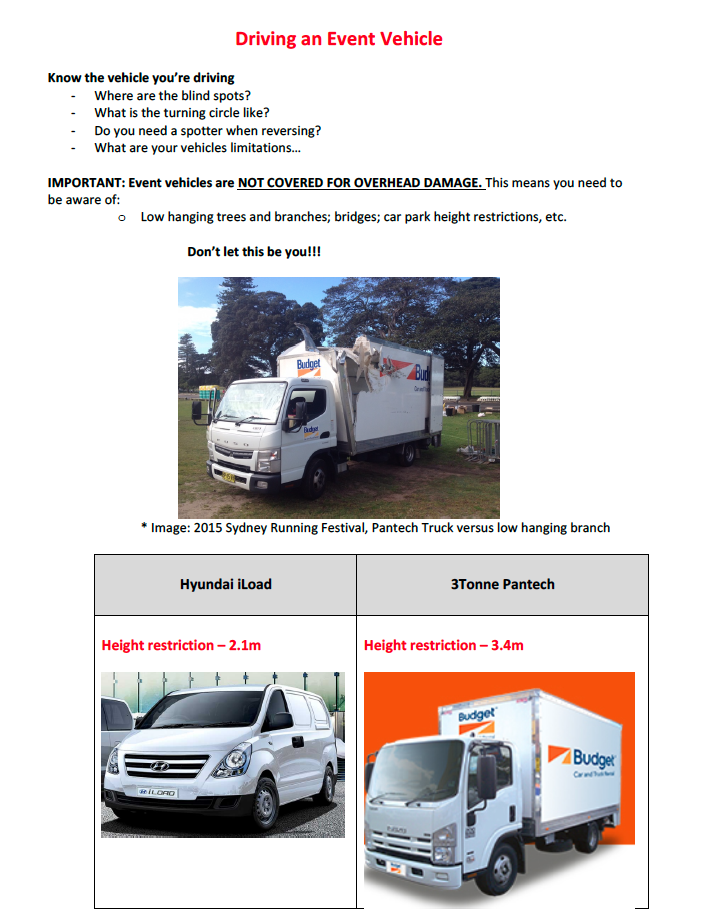
- Overhead damage to Vans and Trucks (Refer to budget hire insurance policy when picking up vehicles).
- Payment of Damages to 3rd Party/Property or insurance excess fees. This will apply where it is proven that a driver of a Budget Hire vehicle has damaged property or been involved in an accident where it is proven the driver of our vehicle is at fault. Liability will include but not be limited to:
- The Company shall claim a maximum of 100% towards any insurance excess claim, where it has been proven that our driver was at fault including damages to other vehicles or property or person.
- The Company shall claim a maximum of 100% towards any payments made by the Company for restitution of property etc where it is proven that our driver was at fault.
- General – The liability of the employee as set out above (a, b and c) will be settled by deductions from wages either:
- In a lump sum or
- Via a prescribed payment scheme (to be arranged individually)
10. CLEANLINESS OF VEHICLES
- Please note that all drivers of budget hire vehicles are required to keep the vehicle that they are driving to a clean standard, this includes:
- Cab area including behind the seat
- Interior
- Exterior
- Tool boxes
- Trays
- Vehicles should always be kept in a neat and tidy appearance. All vehicles should be cleaned and rubbish removed from the cab ASAP on returning to base or destination.
- All drivers are required to clean the exterior and interior of the truck at least once a week.
_______________________________________________________
Thank you for reading the Transport Policy. If you are a driver, please complete the online induction questionnaire on the link below: